Thursday, July 19, 2012

Silly ideas in Singapore: Bomb Shelters


Singapore’s bomb shelters, are they really necessary?
Dr Seow Onn Choong

Singapore has a very good reputation for efficiency and high standards of governance. It has come a long way moving from a third world country to first world status in a very short time. However maybe because of this rapid development some policies doesn't make sense and in my opinion turn out to be silly policies. With the new wave of thinking post election 2011, we should now take time to discuss such policies and see if they really are needed. Most of these policies were never  opened to the public for discussion. I am sure all the government think tanks would have gone through thyem but knowing how decisions are made in commiittees it may not have all the information to make a very good decision.

Bomb shelters in every home.

When one enters a new home either a landed property or a private condominium very often your host will show you a room tuck somewhere near the kitchen. This room has thick concrete slabs and a thick metal door. In it there are no windows except for a small ventilation hole. Welcome to the bomb shelter. I was told you can find such rooms in public housing too.

This contraption is very much a secret in Singapore. It is hardly publicised but when you want to build a new house your architect will tell you that this is a requirement. Nobody can tell you why there is such a policy in place. There seems to be no avenue for you to appeal.

When you dig it up you will find the reason for a bomb shelter in the SCDF (Singapore Civil Defence Force) website. Here are some excerpts from the web page.

Household Shelters

Description of Household Shelters

The Household Shelter (HS) in a dwelling unit is typically the store cum pantry with its walls, floor and ceiling strengthened with increased thickness. The walls are set back by specified distances from the building exterior and the entrance to the HS is installed with an SCDF-approved light protective steel door. The HS gives protection to the shelterees against weapon effects such as blast and fragments during an emergency

Under the CD Shelter Act 1997, new dwelling units (both houses and flats) are required to have household / storey shelters incorporated in the developments.

With effect from 1 May 1998, applications for planning permissions for new flats or houses submitted to or lodged with Urban Redevelopment Authority (URA) are required to incorporate household or storey shelters.


Advantages of Household Shelters

The household / storey shelter has the advantage of being easily accessible to residents of the house or flat and apartment occupants when the need arises. Life during an emergency can thus be close to normalcy. In the case of a residential block of flats, it It is also economical because the void deck space otherwise occupied by a public shelter can be freed for other recreational and social uses, and maintenance cost is minimal.

Procedures for Shelter Occupation

When the need arises (eg. before the onset of a war emergency), the SCDF would increase the public education programmes to prepare the population on precautionary and protective measures. Residents will be advised to prepare the HS for occupation and adopt the appropriate procedures for shelter occupation. Upon the sounding of the "Alarm" signal from the Public Warning System (PWS)., the occupants are to move into the HS. During their stay in the HS, they are advised to tune in their TV or radio for important messages issued by the authorities. Once the "All Clear" signal is sounded, the occupants can leave the HS and resume their daily routine.

National Defence in Singapore

Singapore is a very small country surrounded by neighbours many times larger. Singapore was created through its colonial masters thus there is some sort of underlying resentment as to its existence. Furthermore the majority population of Singapore are made up of Chinese who are considered as migrants to South East Asia. From time to time when elections are being held in the neighbouring countries, inevitably inflammatory speeches are uttered. Thus there is always this fear that the neighbouring countries will invade Singapore and destroy the country when political differences arise.. National defence is taken very seriously. All male citizens must take part in national service i.e. become a soldier boy for 2 years. Then there is the regular armed forces. They are equipped with the latest gadgetry and boast some of the most advanced weaponry that money can buy. The armed forces are the active force and SCDF ( Singapore Civil Defence Force) is the passive force. SCDF organises the general public to be able to take care of the country in war times. SCDF are involved fire fighting, rescue operations, ambulance services etc.

  When in comes to National defence there is very little debate on the subject. Most people until recently do not even know how much money is spent on defence. It can amount to 20% of the country’s budget. I am not sure if there was any public debate about this bomb shelter act.


Is there a need for bomb shelters in the house?.

There are very few countries in the world that has such an Act that makes it compulsory for such a contraption at home. Israel and Switzerland are probably the only countries that make it compulsory. In the cold war of the 50’s it was popular to build nuclear shelters in USA. However nuclear shelters were fairly big underground rooms and equipped with all the necessities for a much extended stay. It was like a replica of a small house so much so the whole family can live in it for weeks.

Singapore’s bomb shelters are different. As can be seen from the SCDF write up they are very temporary in nature. They are very small because as it is the apartments in Singapore are already very small. It is also without ventilation mechanisms or any form energy supply. Thus they are meant for very short occupation.

Now come the crux of the matter.

 Cost.

As the guideline for the construction of the shelter imposes a necessary thickness and strength of the structure, the cost of building it is not cheap. To my knowledge the cost of such a room ranges from $25,000 (twenty five thousand) to $40,000. This may cost even much more so in a tall building as the additional weight has to be taken into account. No doubt property prices in Singapore are very high and the additional cost is not a deterrent. However as a national cost if one totals up the all the cost of each household past, present and future then it is really substantial sum of money. If Singapore built 100000 homes over the last 15 years the total cost for all the bomb shelters will be a whopping $3billion to $4 billion. That is really a lot of money to waste and can be better spend on buying equipment for our armed forces. Furthermore most properties in Singapore don’t last more than 20 years as there is great incentive to tear it down to build newer buildings. These newer developments come ever smaller as the price per square foot is ever rising due to the Singapore phenomenal of enbloc sale. What a terrible waste of resources and time. As we want to be a greener society our guardians insist on adding more rubbish.

Are this shelters really effective?.

It is effective as the SCDF states against shrapnels especially flying glass or other objects. However when a building is bombed, it usually catches fire. Thus the resident of the house or building will be trapped in a burning building. This is made worst in a high rise as the occupants may not even know the building is on fire as they cannot hear the shouts of neighbours. When they feel the heat through the walls obviously it is too late, every occupant will be roasted inside. When the heat rises there will be frantic phone calls from the occupants.

Well if our enemies know this achille’s heel then they will target to set fire to buildings instead of destroying it. SCDF and our army will then be overwhelmed by calls to rescue them. The authorities have created a false sense of security.

Other countries experience in times of war.    

Inevitably as an entrepreneur I would have run into the SCDF when I need to renovate a business premise. Singapore’s style of doing things is fairly unique. The government sets up an agency to draw up the rules and regulation. This agency then police the rules and regulations they have drawn up. However your contractors are not necessarily qualified to understand the requirements. Thus when you want to apply for permission to do things you need to appoint a QP or qualified person who is supposedly knowledgeable to all the rules and regulation. This QP will advise your contractor on how all the requirements. SCDF will not talk to you or your contractor.

Thus in one event I was so frustrated by the outcome that I had personally had go down to see the FSB( Fire safety bureau which is an unit of SCDF).  After trashing out the issue to my satisfaction I posed this question to the officer.

During the Vietnam war, Hanoi was bombed endlessly by the Americans. Did he know whether the residents of Hanoi had any bomb shelters and if not how did they survive the bombings. Well he had no clue. When I told him how the North Vietnamese survive the bombings by running into culverts and just cover the opening with a zinc sheet (which they had build near their place of work or residence) he was flabbergasted. I had emphasised to him how destructive the B52’s were during their bomb runs. There are many names to such bomb runs, the most famous being carpet bombing. Those people who live through it would not forget the name “Operation Rolling Thunder” in which more bombs were dropped in North Vietnam than the combined numbers during WW II.

So learning from the North Vietnamese, we should be building culverts and not bomb shelters.

The maid’s torture chamber.

Nobody wants to talk about this issue except if you search the expat forum you will find foreigners very amused. To make matters worse most of these rooms are used for maid quarters. Imagine sleeping in a room where there is little ventilation. If they close the door for privacy, the room becomes very stuffy. I don’t think the authorities allow aircons in these rooms. If they open the door then there is no privacy. I wonder why the governments of countries who send us maids have never brought up this issue.

I remembered the prime minister’s wife bringing this subject up once in the papers. She is an engineer by training. Nothing has come out of it.

The Swiss experience.

It seems like very soon Singapore is the only country in the world that builds bomb shelters in homes. Switzerland had one of the most elaborate self defence force and inevitably made construction of bomb shelters in homes compulsory. However times have changed for the Swiss. They have found these shelters becoming redundant. Now they are usually used only as storerooms and some even completely locked away. As usual with a historical baggage it is not easy for the Swiss to completely throw away the idea. They have allowed the locals to pay a fee. They called it a fee to pay for a space in a public bomb shelter which the government builds.

We are not so lucky in Singapore. There is no such option. However if you are building a house and can retain some structures of the old house then you may be exempted. Hmm if bombs drop from the skies how can they differenciate an old house from a newly built one?

We are an inclusive society.

Recently we have been told our society is moving towards an inclusive society. I find it a bit difficult to understand the term. I have been checking with many people and asking them what they know about the policy of bomb shelters. To my surprise literally none can come forward and tell me the rationale behind this policy. As far as I can remember there was no public discussion on this issue, thus nobody really knows why it was needed. So how can the authorities implement a policy that affects every house owner without prior consultation.

Soon we will be celebrating our 50 years of independence. Through these years Singapore has become a very developed country. We have a population over 50 years of age highly educated and with very good experience of every aspect of life. If we tap into the knowledge by harnessing the power of forum groups, the country can do very much more for our citizens without making such mistakes that can incur a lot of money. I am sure there are better ways to do things.

Monday, July 9, 2012

Singapore Airlines (SQ) may not be a great way to fly afterall.

Singapore Airlines (SQ) may not be a great way to fly afterall.


As a dentist I work within four walls of my clinic. Many of my successful friends and patients tells me of their enjoyment when they fly all over the world for work. They usually do so flying business class and more often than not Singapore Airlines superior service is mentioned.

As for me flying on Singapore Airlines is akin to doing national service. I am proud of our national carrier but I always feel they don’t treat me with reciprocal respect. Why do I say so?. When you buy a SQ ticket, it is always more expensive than any other airlines available on the Singapore market. Many of my foreign patients fly on SQ because of the service and reliability but they also mentioned a price that is a huge discount to what we can get here. From my patients who are staff of SQ they say this is due to their business strategy as they can maximise their profit. Erh, at the expense of Singapore residents? Do you mean all airlines in the world milk their own countryman?. As I dentist there is no need for me to fly unless I am going on a holiday.  Usually those destinations for holidays are not too far away, thus the differential cost of the ticket in economy class is not that high and I really don’t expect much of the service.

Recently things have changed. I am much older now and no longer need to worry about my finances. Like the wise sage taught, if I don’t spend the money I have earned it is not mine. Now I have the opportunity and time to travel to far of places. Why not fly business class? The internet has enabled us to check for prices of air tickets and also booked it directly. Thus in the comfort of our home environment I can compare the prices of the fares available. To reinforce what I have said earlier SQ charges are usually significantly higher as much as 30%. With the significant savings flying on other airlines both me and my wife can take off together.

SIA has many challengers on the market. The most notable is Emirates follow by Qatar and Cathay Pacific. The middle eastern airlines have been marketing themselves very aggressively. As they have grown in fleet size they are also flying to many destinations. There is one inconvenience. On all flights to Europe there is a stopover in one of the middle east country. However since I am flying on business class and on a holiday, it gives me ample time to enjoy the service provided.

Every year I need to fly to Australia once. This time I decided on Brisbane because I have not been there for some time and as June is a winter month, sunny Queensland should be ideal. Of my usual favourite airlines only Emirates and Singapore Airlines fly to Brisbane. Unfortunately Emirates fly on an unearthly hour i.e they depart Brisbane at 2.30am in the morning. On my last trip to New Zealand flying Emirates, there was a stopover in Brisbane which lasted for 6 hours. Yes it departed at 2.30am from Brisbane making it a bit difficult to sleep. So that leaves me with SQ. A check on the ticket shows it is 30% more expensive. Well just before I made the decision to buy the tickets a former Silkair staff came for her check up. As the conversation went, she being a very loyal staff was defending her company. So i need to check it out as I have not flown on SQ business class before. Well as it went SQ flights to Brisbane had the right timing.

So I went to SQ’s website to book my tickets. Easy enough but then I realise they were using the older Airbus on this route. On these older planes the business class seats are of the older vintage and not as luxurious as the new seats they had advertised. Too late I have already booked the tickets. SQ has one extra option. They have a button for meal selection and to my surprise there was an offer to choose your cook. Well when you select this option, it highlighted 2 offers on the outbound trip. A choice of either steak or prawns. OK so I selected steak for myself and prawns for my wife. For the return trip the offer was different. So I selected seafood meals for both.

A day before the trip I was notified by email and a sms message requesting to check in online. So I went online to check in but due to some issue I cannot understand, I could not do so. Thus I had to check in at the airport. What amazed me was the email and sms they sent to me did not highlight which terminal I had to go to board the flight. SQ flights take off from both Terminal 2 & 3 of Changi airport. I had to google the flight to find out. Check in was easy as we were early. So we made our way to the Kris flyer lounge. It was pretty crowded but we found our seats. The food selection was quite small granted they had such a big lounge and with so many people inside. Not really appetising for me and my wife. I was looking forward to my steak. The flight was to depart at 20 minutes pass midnight and as we were told that there were no boarding announcement we had to look after it ourselves. So just 20minutes before the closure of gates we walked towards our flight gates. To my horror we realised that the gate was on the other side of the Terminal 3 and we need 18 minutes to reach it. A quick step walked became a bit of run.

We were welcome on board in good time because there were other passengers still strolling in. Obviously SIA may be phasing out the plane as the cabin looks a bit dated. After the usual drinks the stewardess asked if we wanted our meals after takeoff or before it landed. As for me I would like my steak fresh. My wife chose the option before landing. My steak came in due time. As they say airline food is not too appetising. This steak was no different and really did not live up to my expectation. Never mind I made up for it by watching the movies and had some wine. I cannot fault SQ as they have a good selection of Asian movies. Before I went to sleep I went to brush my teeth. I took one of the toothbrush from the amenities cabinet. To my horror after a few strokes I can feel the bristles coming out in my mouth. Shocking that SIA can offer products of such quality.

When I woke up in the morning my wife was just served her big prawns. She was not too keen to eat big prawns at that time of the day. The steward asked me if I wanted a drink. So I told him that I wanted a glass of orange juice. Then I waited. Nothing else came. There was no breakfast for me but I did not know that. I had to ask for my coffee. Whoa this is the first time that nobody asked if I wanted breakfast on a night flight.

Time passed quickly especially with the wintry climate Brisbane was having. It was time for our return trip. It was an afternoon flight. So off we went to Brisbane airport. We had 2 carryon bags. We were very surprise when the counter staff asked us to weigh out carryon bags which were quite small. One of them weighed in at 8 kilos. She told us the weight limit was only 7 kilos and this was due to safety requirements. Again this is first time we have heard of it. All other airlines we had travelled on allowed 10 kilos. Don’t tell be the cabins on SQ planes are not designed for bigger luggage?        

Once again mealtime came. The stewardess came to inform us that we had ordered seafood meal. Since my wife had a stomach upset she checked with the staff to see if there was cream in the seafood meal. As the reply was positive she asked for Chinese meal. What do you think the reply was?. The stewardess said as she had ordered a sea food meal there was no other meals available for her. However if other passengers do not choose the Chinese meal then she can have it. Wow? Fortunately there were only 4 chinese in the cabin and she got her meal. I had my seafood meal. The starters were 4 prawns on a bed of salad. When the main course came it was really disappointing. There were prawns and pieces of salmon on pasta. The food cannot even compare to the pasta at Pastamania, a popular fast food chain. How can it be on a special menu? Better to send the chef to the fast food chain for some lessons.

One matter of interest. On all the other airlines we were provided with a toiletry bag. Some airlines have very elaborate bag designs. No doubt in this green world and especially for those who fly very often, there is no necessity. For those who are irregular flyers, it is a good token. The bags are very suitable as giveaways to friends or relatives. It is a very convenient toiletry bag. Isn’t it a good marketing giveaway?. At least give the passengers a choice if they want to receive it.

Let me share with all SQ or SQ related staff my experiences on other airlines.

Let me start with Cathay Pacific as this was the first airline I flew on business class. The seats are Ok just a bit tight but can recline fully i.e lie flat bed. They have all the seats arranged at an angle to maximise the numbers, a bit awkward for the ladies when other passengers move up and down the aisle. The meals came all together for every passenger i.e they still have mealtimes. However if you miss your meal you will have to make do as they will cook you a wanton noodle. No, you need not go hungry as they have a selection of sandwiches. When you go to sleep they will offer you a very comfortable duvet. The crew were always ready to serve. Breakfast is a given. Their business class lounge at HK airport is pretty large. They have a variety of food. The one I like best is the wanton noodles made on request. Well HK is famous for wanton noodles isn’t it? On my next trip to HK they upgraded my return leg to business class.

The next time I flew was on ANA. It was a trip to New York with a stopover in Tokyo. The plane for the Tokyo bound leg unfortunately had old fashion seats and thus not a big deal. However they had just introduced the new seats on the Tokyo to New York sector. They were very spacious and very comfortable with more privacy. The business class lounge in Narita was not much to talk about. They have a udon stall. Not my favourite Japanese food. The only setback flying on ANA is the air crew cannot converse well in English and thus I had difficulty in asking for any variety of food offered on board. To make things worse the movie selections were in Japanese or in the original language.

 Emirates came into my mind when I had to go to New Zealand and Australia on a business trip. I was surprised they have flights that cover so many cities of Australia. On their website I could book the different sectors, something new and called open jaw booking. The only problem was there will be a long wait in Brisbane on the return leg. On departure day a limousine came to our house to deliver us to the airport. This is a complimentary service. You should have seen their business class lounge at Changi airport. It was very large and not crowded at all. They had a very good selection of food and to top it all, the staff even came to serve you as if you are in a restaurant. When it was time to board the plane the staff walk by to announce it. There was a special gate that led directly to the plane. Literally we were boarding the plane as the gate closed. Service on board was very good and we had all our meals including breakfast. When we landed in Melbourne there was another limousine to send us to our hotel.

Our next leg was from Melbourne to Auckland. To our surprise the Emirates business class lounge at Melbourne is an exact copy of that at Changi airport. This is true for the lounges at the airports of Auckland and Brisbane.  Since they are very large lounges they do not feel crowded at all. Well the best part of my flight was we were upgraded to first class seats from Brisbane to Singapore. Wow this is the first time we are flying on Emirates and we were upgraded. Needless to say service in the first class cabin is overwhelming. Again there was a limousine to pick us at Changi airport.

Most recently we had to go to London on a urgent trip. A check with the websites gave us an idea of  the prices. Needless to say SIA’s fares were much more expensive. There was a technical difficulty on Emirates’s website. You see my son was travelling with us on this trip. Being a young person he wants to travel on economy. No matter how I tried it was not possible to put us on the same plane. So I went to Qatar Airways website. The fares they quoted were not much more than SQ’s economy fare. So we were booked as a family.

Qatar Airways do not have their own dedicated lounge at Changi airport. They do not provide the limousine service as Emirates. Their business class cabin must be one of the latest and most spacious with very large seats. It is their onboard service that is very impressive. There seems to be many air crew on board and they are always around to serve you. When it came to mealtimes we were offered the menu. There were many options available. To our surprise the stewardess told me I can have everything item on the menu if I wanted. Not only that, if I do not feel like eating now they can serve me when I choose. You should see how they serve you on board. It is like eating in a fine dining restaurant with many courses. Service on board was probably the best I ever had.

It is easy to converse with the crew on these middle eastern airlines. They all can converse in English fluently. The reason is at least one of the crew would have a connection with SIA. Inevitably one of them on board would have worked for SIA and joined these airlines. So you can see they have learned all the service qualities from SIA and improved on it.

Sadly SIA may have sat on the high pedestal far too long. As I exchange notes with my contemporaries who no longer fly on company trips but their own private trips, they all share the same conclusion with me. That is it is not worth paying the price of air tickets SIA charges as they can get very much better value on other airlines. Yes one can say we are still the minority but as you can see the numbers are growing. Bear in mind in all the wealth surveys recently Singapore is a very rich country. There is a big pool of silver hair folks who would like to enjoy a bit of life before we move on to the next world. Instead of taking advantage of the situation SIA is antagonising its largest pool of potential customers. If SIA’s countrymen refuse to fly on its national airline, what would entice others to fly on SQ?
Dr Seow Onn Choong is reinventing himself.

When I was a young dentist the retirement age of people then was 55. I supposed my target then was also to retire at 55 as some believe a dentist's hands will be  shaking by then.
I have tried many times to retire but doesn't seem to be very successful in doing just that. 5 years ago I decided to sell my practice consisting of 4 clinics away. What triggered the move was the death of my eldest brother. That was a good opportunity for me to fade away as the sale requires me to work for the new company for 3 years. Well I went on to work part time for another 2 years until a change in management triggered another retirement.
Well I thought this is it. I was wrong. A flood of phone calls , sms messages and emails came. To make matters more exciting I started running into all my former patients and once again the questions are the same.

So at last I am reinventing myself by staring another  clinic now known as Dr Seow Dental Centre. It is jsut right next door to my old clinic in Holland Drive.
Thus the address is Block 43 Holland Drive #01-51 Singapore 270043 Tel. 67770113.

I have been a rolling stone all my life. I started work as a government dental officer but concurrently I was given 2 other jobs. One was as a part time lecturer in then the University of Singapore. The other was as dental officer in charge of Woodbridge Hospital and Tralfagar Home. THose days there was no handphones, thus none of my colleagues knew my absence.
Government  service was alike a stone wall. I kept knocking my head into the wall as the people involved were most resistance to change. Finally over  $50 dollar call allowance I resigned.
I joined Tay and Partners. It was a young group back then but was very advanced in its ideology. It was the place where I picked up most of my dental skills especially four handed dentistry.The training was good enough for me to sit for the Master Degree in Dental Surgery from the National University of Singapore. I am probably the only MDS degree holder from NUS that was not a government or University trainee.

Soon I felt it was time to set up on my own. My first clinic in Plaza Singapura was known as AARON DENTAL SURGERY. Aaron because it appears as the first name in the yellow pages. That was the most the most important lesson from my  former boss. Little did I realise that it was not to be so easy. As a Malaysian, I had very few friends in Singapore. Also most people did not trust a young dentist.

Fortunately fate is kind to me . One of my medical doctor friend who was the working in Brunei suggested I go to Brunei to start a practice.It was a easy decision but had to convince my girl friend to marry me and follow me to" that god forsaken place"

So I started AARON DENTAL SURGERY in Brunei. However one day a Malay man came into my clinic asking for Dr AARON. As far as he was concern I could not be Dr Aaron as I was not an englishman.
That triggered me to think. Thus AARON SEOW DENTAL SURGERY was born.
Brunei was the best thing that  can happen to me. Within one month my clinic was very busy so much so there was period of 3 days I worked from morning to night none stop. On the fourth day I told my newly wedded wife I had enough and I closed the clinic for the day.

Brunei was a really unique and most important milestone in my life.The people of Brunei is very friendly. There was only 2 dentists in private practice then , one charge the sky and the other cause a lot of pain. Even thought he government provided free dental care, the service there was atrocious. Everyone gave me a try. The best part was whatever I did for them, if the results did not turn out well they will comeback to give me feedback and ask me for a better solution. This was how I could hone my skills so much so my patients called me The Best Dentist in the World.  I am not bragging cos recently when I went back for a holiday after 14 years many people still remember me and then they poured out their dental woes.

AS events went, I came back to Singapore to facilitate my children's education. That was supposed to be my first retirement , but as a Malaysian I had to be gainfully employed to stay in Singapore. I worked for a friend but every alternate week I flew back to Brunei to take care of my patients.After 5 years i had to stop because it was just too tiring and thus AARON SEOW DENTAL SURGERY was born again.

Is  DR SEOW DENTAL CENTRE the last of seow onn choong's revival?. Time will tell.

Wednesday, November 2, 2011

Bringing changes to Cambodian dentistry

Introducing 4 handed dentistry to Cambodia
Fate leads people to many destinies. For me the moment I got into dental school there was no way I could exit my destiny as a dentist. Fate would make me even take a pay cut to leave for private practice and introduce me to the world of 4 handed dentistry. Tay and partners was then a young dental practice in Orchard Road, Singapore. It was ahead of the times.  It was also where I learnt how to deliver dental care in the most efficient and productive manner.
                                           Both dentist and DSA is seated down


                                        Patients cannot see the instruments
                       
                                           All four hands in action

                                   You can even use your left habd to take out teeth so no strength needed

Till today I am very surprised to find the majority of dentists all over the world who have no clue what 4 handed dentistry is all about. Dentistry is basically manual work. No matter which procedure is performed for the patient, it can be broken down into many simple and repeatable steps. The oral cavity is a very small worksite. All the materials and equipment need to be delivered to this worksite to finish what is needed to be done. The dentist being human must be able to conserve his movements throughout the day so that at the end of the day he is not stressed or tired. The patient obviously benefits from it as one need not open his mouth for too long.
The concept of 4 handed dentistry.
All dental procedures can be simplified. They also can be done with the least number of instruments and materials. More important a dental assistant can be taught how to deliver all the necessary instruments and material for the dentist to use. As such the dentist is fully focused on the work and using only finger and wrist action can deliver the highest quality of dental care.  With the additional hands of the assistant the term 4 handed dentistry was coined. It can also be extended to 6 handed dentistry if one more nurse is brought into the picture.
                                                              The ideal dental chair
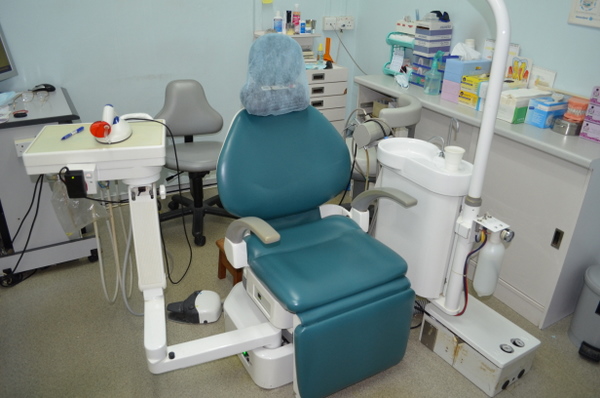
One must start from the design of the clinic. The flow of patients and staff to and from the treatment area is very important. The patients should be able to reach and exit from treatment area is quickly as possible. The majority of dental chairs used by dentists all over the world is not ergonomically design for the patient. There is this equipment arm that is a barrier to the patient getting on to the chair. Personally I can never understand why dentist must be a slave to this arm, pushing it in or out every time a patient is seated or even when they want to rinse their mouth in between procedures. Imagine how much time can be save in their life just by using a different design.  
By introducing 4 handed dentistry to one’s practice , the productivity can be increased by at least 30%.  If the clinic setup is well planned, I am sure most dentist can double their productivity. If you extrapolate over the lifespan of a practicing dentist it is extremely significant.
The Cambodian challenge.
At a lunch gathering I was seated with Dr Khov Sov president of the Cambodian Dental Association who was visiting Singapore as a guest of the Singapore Dental Association. 3 other prominent Singaporean dentists were present. The conversation lead to the discussion on seated down dentistry. One of the most important rule in 4 handed dentistry is the dentist and assistant must be seated down at all times so that both of them have a clear view of the operating field. However as I found out I was the only dentist at that table that do so. My Singapore colleagues were arguing that is technically impossible to do all dental procedure seated down. Dr Khov Sov was surprised that since we were all graduates of  Singapore dental school we have different working style.
So here I am in Phnom Penh. As this was my first trip to Cambodia, I wanted to see for myself how Cambodian dentists are doing before introducing to them the art of 4 handed dentistry. I am quite sure nearly all Cambodian dentists practice 2 handed dentistry as few dental schools in the world teaches 4 handed dentistry. To change one’s style, one needs to completely change the mindset. Fortunately all the dentists I met were very young and eager to learn. As usual most questions they posed  focus on whether I do implants for my patients. There were surprised that I don’t. They were more surprise to hear that I am so productive such that I can earn a very good salary just doing very basic dentistry.
Visit to the dental school.
The dean
This brings back memories to me as the Cambodian dental school looks similar to  the facilities I was attending back in late 70’s. The dean was very kind to meet me and spoke at length of the changes to the school. The school is expanding and upgrading their facilities. It would be ideal if they can  introduce 4 handed dentistry to their students.

                                         The overhanging arm I mentioned


Taking one step at a time.
The first step was to conduct a clinic for some dentists at Dr Khov Sov’s practice. Four of his classmates turned up for the session. I put them through a slide show introducing them to the idea. It was difficult to impress them as I did not have it as a hands-on demonstration with my own dental chair setup and with a trained nurse assisting me. Well to add more fun I had asked Dr Khov to arrange for a patient with a mesio-angularly impacted wisdom tooth for me to perform a live demo. His clinic assistant came in as the right candidate. Obviously his setup was not for 4 handed dentistry. Still I managed to demonstrate to them how one can perform a surgical removal of  a wisdom tooth seated down. It also gave me an opportunity to show them the use of the subluxator for speedy extractions. They were amazed that  the whole procedure took only fifteen minutes.


my first group of students

performing the operation in a seated position


 A very bright future for them
It would be an uphill task to bring 4 handed dentistry to Cambodia. Their equipment does not pose any issue as their present dental chairs are modern. With the addition of the assistant’s mobile clinic they will be able to start on it. However just as any new skills, a lot of hand holding is necessary and as old habits are difficult to discard, most dentists will fall back when they are stuck with nurses who are not able to assist properly. In my own clinic all the nurses are trained to assist any dentists who join us. They are thus able to coach any newcomers.
However I can come back again to Cambodia to show them again if the need arises. The ideal place would be to conduct the program in their dental school. This would enable a group of DSA’s to become well verse in the technique and be able to promote it. This should go for all other countries. Ironically I am not able to do so in my own country.

                                          A visit to a rice paddy farm

Its great to meet new people from all over  the world.
I wish to thank the Dean , Dr Khov Sov and his friends for giving me this opportunity to share my experience with them.

Tuesday, October 18, 2011

Singapore may have saved Phnom Penh from the great flood

Singapore may have saved Phnom Penh from the Great Flood.
The recent heavy monsoon rains have caused severe flooding in many south Asian countries notably Thailand. , Cambodia, Laos, and parts of Vietnam. This year's flooding is so severe that more than half of Thailand is coverd with water and severely threatens the capital city of Bangkok.  Television news broadcast shows huge swaths of land affected in these countries.  The flood water in some areas have reached the roofs of most of the houses.. One must bear in mind this houses are already on stilts.
The citizens of the city of Bangkok were in a state of frenzy with rumours swirling that the low lying city will be completely submerged by flood waters. To make matter worst there is nowhere to run as most of the country side is flooded.
As my plane flew  into  Phnom Penh airport , I can see through  the windows the large acreage of flooded areas. I was not sure if the plane is going to land and if the airport is flooded. Fortunately all went well and I was received by my host Dr Khov Sov. He assured me that the whole of Phnom Penh and its surrounding areas were not affected by the flood. The flooded areas were far from the city..
This is my first trip to Cambodia. I am on a personal mission to share my experience with Cambodian dentists. I am trying to introduce to them the art of four handed dentistry. I  have been practicing this style of work for 30 years delivering quality dental care quickly and efficiently. This is the most productive style of dentistry but alas few dental schools teach this method or even know about it.  
A friend had arranged for me to stay atthe River 108 Hotel. This hotel is located just across the road from the Mekong river. The Japanese government had developed the river bank into an esplanade and in so doing beautified the area. There are lots of small hotels in the area and is very popular with tourists. Since I had the afternoon off after visiting the dean of the dental school I wanted to take a river cruise just as the one I took on the river Seine.


To my pleasant surprise the hotel had sent one of their staff who was fluent in English to accompany me. The best part was the two of us had the whole boat to ourselves. The itinerary  involved travelling to the confluence of four rivers of which the Mekong and Tonle Sap  were the largest. I can see the water level is very high and probably about 1 meters short  of overflowing  the banks. My guide told me he had never seen such a high water level.


high wate level at the esplanade
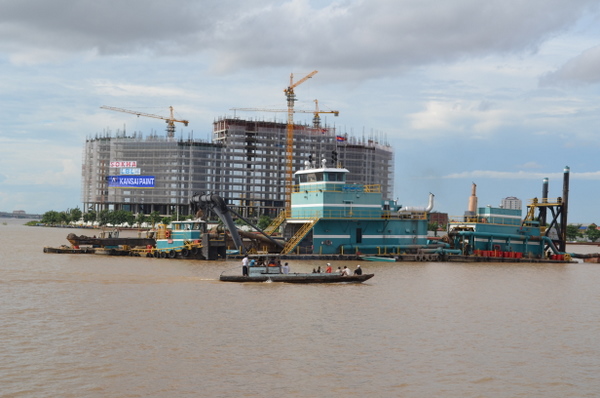
Soon we cruising down the river. At the confluence of the river  was a sand mining ship. I was very surprise to see such a large vessel in this location. Then I remembered that Cambodia supplies sand to Singapore but I was still taken aback that this vessel is located in the capital. My guide said that this vessel has been working in this area for about two years now but he was very surprised that the sand was destined for Singapore, a land 1000 kilometres away.


Sand mining ship at the confluence of Mekong and Tonle Sap rivers
Now comes my observation. Could it be that Phnom Penh was not flooded because its river has been dredged?  Although most rivers are very wide but they are very shallow during the dry season. as overtime they  have been  silted up. By dredging them regularly they are deepened and results in swifter water flow. So when there is a large amount of water coming from upstream due to heavy rains they can drain the waters away pretty fast. This results in  the neighbouring areas not flooded.


                                             Flooding in the villages
Dredging rivers is an expensive task and worst of all the sand dredge up have to be deposited somewhere. Furthermore environmentalist has always condemned such practices citing erosion and resultant damage to the environment. Thus no governments have any budget to dredge unless iy is to deepen the river for ships to sail through. I have always suspected great floods are caused by human beings not managing their rivers. Little do we think of agriculture can caused lots of erosion that washes all the soil into the river system. This is in turn aggravated  by human activity of deforestation, construction etc. which dump a fair amount of rubbish into rivers.  When the great floods of Queensland occurred last year I concluded the Australian government had not maintained their rivers and even when the rains had died down water was still around for some time, This was true also of the great Pakistan floods.
Phnom Penh has possibly shown us that managed and regular dredging of rivers can reduce the amount of land that is flooded and thus save us a lot of damage and human misery.
Well I will let the scientists prove me wrong. Like I said maybe Singapore saved Phnom Penh from the great flood.

Saturday, July 9, 2011

Prevention of flooding in Singapore

Transient Dams

Dr Seow Onn Choong
As we are all aware the recent floods have caused a great deal of discomfort  and loss of money in the areas affected. To make matters worse the recent  flooding of Tanglin Mall and St. Regis Residences coincided with the anniversary of the flooding of Orchard Road just last year.  PUB is at a loss on how these disasters can be prevented. Orchard road 's level was raised at a great cost with buildings installing flood barriers. This had now shifted the floods further up the drainage system thus affecting Tanglin Mall area.
Many suggestions have been put forth. These include building additional canals running parallel to the existing canal or building underground storage tanks near these flood prone areas. AS PUB has put the blame on climate change would these measures be successful. Furthermore the construction of such devices at such built up areas will not only be very expensive but extremely  destabilising to the surrounding businesses. At best we are only trying to treat the symptoms.
What is the real cause behind the floods?
Climate change may be the cause but we cannot blame nature. We have no control over it and at best  must adapt to it.
The most important factor is also a man made problem. I would  like to call it the increase concretetisation of Singapore. As you can see there is rapid development in Singapore with construction of ever bigger shopping malls and homes. All these structures and the associated land are contributors to the floods we see. The rain does not just fall on the flooded areas but also on every inch of land.
Many government policies have also contributed to the sudden deluge of water. The most obvious is the efficient drainage of  water. When we see things locally we want to build drains that can drain away all the water as swiftly as possible so that the area does not flood. Recently one can see that most drains have been covered up.  This has brought us more walking space and also more greenery. However I was told it was meant to prevent leaves from falling into drains and thus do not end up in the reservoirs.  In addition gutters have been banned and the traditional water storage tanks for watering gardens have now been abandoned.
My proposal is very simple. Every building or land owner is a stakeholder and contributor to this flooding  problem we are now facing. We must now make every stakeholder hold on to the rain water that falls on their compound and release it at a rate that does not affect other stakeholders further down the drainage system. This would prove to be a cheaper and faster method to be implemented. It can be also used in all areas that was flooded  not just those prime areas.
Methodology.
The function of transient dams can be likened to fire rated doors. These doors are meant to delay the spread of fire in buildings so that not only can it give the occupants time to escape, It also enable the fire brigade to do its job without the building being gutted. The design of these dams is very unique.  When there is no rain  or during light rainfall water flows through this dams without any resistance.  This is possible by allowing an opening at the  base of the barrier. Thus there will be no stagnant pools of water or silting at the barriers. When heavy rain occurs, the amount of water reaching the barrier is now restricted by the flow rate through the opening. Thus water will build up behind the barrier . The top of the barrier is lower than the height of the drain . When the volume of water is too much for this section  water will overflow the dam into the next section . As such excess water is released . This prevents flooding at the vicinity of that dam. Technically speaking if many such dams are built in a drain , the whole  drain can  be converted into  a temporary reservoir. Now if you can imagine if all the drains in any drainage area is dam up , a giant reservoir can be created. Once the rainfall slows or when the rain stops, water will slowly drain away from this temporary reservoir.   Please see diagram to understand the construction of the dam.


The most important task is  to make a survey of all our drainage system with priority given to those areas affected by the floods recently.  With the information obtained  we can  outline all the contributors of the water to the flood prone areas .Next we must build transient dams in all  the drains involved.
Every building must install such dams at  their outlet which connect to the public drains. In addition they can construct water features to enhance the retention of water. These  water features can contribute to watering of plants in their compounds thus avoiding the present wasteful system of using tap water. In public areas which are relatively lightly developed existing  drains can be enlarged and deepened to create a bigger volume to hold the rain water. A good example is Dempsey area which in all  probabilities contributed to the recent Orchard Road floods.
In comparison  to those suggestions on prevention measures as outlined earlier, my proposal of creating transient dams could be the most effective  both in cost and the  quick delivery of the system  The dams are simple and cheap to construct. The existing infrastructure can be converted without any interference to the existing stakeholders
  Initially one  would need only  angled  metal bars and wooden planks. Since the dams are made of wood their effectiveness can be easily adjusted and the dams can be removed once better or more permanent flood prevention methods are introduced.
In future the design of drains must be changed not to drain water swiftly away but also to hold on the water for a period of time. We must also encourage homes and buildings to store rainwater not only for watering their gardens but also to use in their toilets. It does  not make sense for us to send our rainwater down the drain to be process and then bought  back to water our gardens. The fear of mosquitoes infestation can very easily be overcome as there are many  preventive measures.

The priority now is  to stop flooding in Singapore. We will never know when the next big storm will arrive.


Dr Seow Onn Choong   19 june 2011

Sunday, June 19, 2011

Singapore's success story. Can it be repeated elsewhere?

Singapore success story, Can it be repeated elsewhere?

Dr Seow Onn Choong

The tiny island of Singapore is home to 5,5 million people with the second highest per capita income in Asia just behind Japan. It has no natural resources and nearly everything it consumes is imported. When it first gain its independence in 1965 nobody would give it a chance of survival and many believe it will soon be grovelling under the country that gave it independence. 46 years on , the story is so different.
Its largest neighbour Indonesia gave Singapore its nickname , the tiny red dot. Obviously it is with reference to its majority Chinese population and its size being so small that militarily it could be run over easily. Little do they know they were one of the main contributing factors to Singapore's success story.

Singapore has a very large expatriate population. As a dentist inevitably I get to treat many of them. it is also my habit and source of enjoyment when I talk to my patients and through it develop a good relationship with them. There was one such lady from Ireland who was one of the directors in GSK. GSK is one of the largest drug manufacturer in the world. they had built a very large high tech  factory in Singapore. She was very curious about  Singapore's success story. As she was in a high level position, she had met up with high level staff from the Economic Development Board who were the architects of Singapore's industrialisation. To attract high tech investment such as from companies like GSK, foreign companies are given extremely good tax breaks for a period of 10 years. She was curious how Singapore can benefit from it and if The Singapore success story could be repeated elsewhere. She was not satisfied with the explanations provided by the EDB officers. She was told Singapore was in an ideal location with an educated workforce and a good government. This were all the factors for its success. To her these were not special as many countries have such similar conditions. Well she thinks her dentist can provide her with the answer, well of all persons.

Yes I d because I am from the era and is part of the Singapore success story. I was born in Malaysia in 1954 in the town of Kuala Lumpur. Due to circumstances at that time I ended up in Singapore University in 1974  as a dental student .Even though I left Singapore in 1984 to seek greener pastures in Brunei , I finally return to Singapore and eventually became a citizen. Thus I can see the Singapore story better than a Singaporean who has not left its shores.

There are 4 reasons for Singapore success. Most countries would have one or 2 of them but I don't think I have read about any with 4 together.

1) Lee Kuan Yew
He is the founding father of modern Singapore. He is the right man at the right place at the right time. A brilliant man who brought up in Chinese environment , he had the opportunity to study law in Cambridge , England.
Thus he was exposed to western ideas yet steep in Asian culture.
It was the era of change in the late 50's and early 60's. Britain was under financial strain and were giving up her colonies one by one. Second world war had  shown the colonies that their masters were not invincible. Thus through peaceful or violent ways, all the colonies were striving for independence.
 Communism was gaining ground in Asia after the Mao Tse Tung unified China. Singapore had a majority Chinese population who then look towards China as their motherland. Malaya had just gone through a period of communist insurgency. The tactics used by the communist were very harsh with many threats and assassinations. Lee Kuan Yew and his colleagues were very forceful in their handling of the threats posed by the pro-communist factions. Many of them were jailed ,some without trial. The government also took over the trade unions which were then fertile grounds for the communists.
The hall mark of Lee Kuan Yew's administration was a corruption free government. Corruption was endemic at that time and without eradicating it, no young country can survive its ills.

2) "You are all coolies' The local Singaporeans
the first time I heard about the phrase, I was quite angry. My Hong Kong patient was trying to explain to me why the population of Singapore can be subjected to strict rules in the country and still does not oppose the government.
His rationale was very simple. There are 3 places outside China which had a majority Chinese population. They are Taiwan, Hong Kong and Singapore.
A closer look shows that the chnese who migrated to these 3 places are very different types of people.

Taiwan is an island just off the eastern shores of Fujian province. Prior to the exodus of Chiang Kai Shek's armies after the their loss to the communist , it was an unimportant island. Obviously there were original Taiwanese people but they were overwhelmed by this refugee group of armed forces, warlords, and wealthy people.
Taiwan had a authoratian government during the reign of Chiang Kai Shek. It was more a less a police state until democracy took hold after the collapse of the Chiang dynasty. Even with its so call democracy, politicians can be seen fighting in parliament and when the masses do not agree with the ruling government they will demonstrate on the streets. As can be seen the Chinese in Taiwan are not the subservient type.

Hong Kong was under British rule. It became a British colony as a result of the opium wars. Effectively it was founded by British merchants and thus trade was the main concern. The Hong Kong Chinese were attracted to it because of the opportunity to make money. It was enhanced by the mass migration of business families from Shanghai who brought along with them even more money making skills. For all the Hong Kong Chinese making money was utmost of importance. the British can govern as much as they like so long as the conditions suited both parties. Politically the Chinese never develop a sense of belonging and eventually the confidence in governing itself. Hong Kong thus attracted many Chinese of the merchant class while the worker class who came along was subdued by the British money making trading houses or Hong's.

Singapore was situated at the most southern tip of the Malaya Peninsula which is part of South East Asia. Tin mines, rubber plantations were all sprouting up to feed the demand of raw materials needed by the industrialising western countries. Boat loads of workers were streaming in not only from southern China but also from the Indian state of Tamil Nadu Singapore was fast developing as a port . Not only were most cargo being handled through the port , it was also the first port of call for migrants.
The majority who arrived in south east Asia (SEA) were the poorest of.the lot in their homeland. Nearly all of them were trying to escape extreme poverty due to the many wars in China. Food was scarce and there was no law and order back home. Thus as the story spread in southern China about the wonderful opportunities in SEA ,boat loads were arriving by the day. In fact those who had arrived will send  money home so that all their relatives can join them here.
The mantra then was simple. Don't cause any trouble with the authorities and you will not be send home. Always be on the good side of the law. That was what my mum repeatedly drum into me when I was a kid.

So now you can understand the source of Singapore's very obedient people. This set the opportunity for Lee Kuan Yew's government to rule with an iron fist.

3) Suharto and the Indonesian purge in 1965.

One of Singapore's largest neighbour is Indonesia. This country is huge in comparison not only in land mass but also in population. The majority of Indonesians are like the Malaysian Malays. They make up more than 90% of the population. Once again there are Chinese migrants who make up about 3% of the population. Unlike Singapore and Malaysia , Indonesian was ruled by the Dutch. Since they already have such a large local population there was no necessity to bring in migrant workers to exploit the land. Thus the small Chinese population. Maybe it is due to the climate and subsequently the abundance of food resources  the locals ( that includes the Malays in Malaysia) were very contented with whatever they had. You will be surprised , the simple coconut tree can provide virtually all the needs of the locals. Its fruit can provide not just a drink, it also provides milk that is used for cooking the favourite curry. When you squeeze the dried kernel you will get coconut oil which not only can it be use for cooking but also hair oil. What is left can be chicken feed. The shell can be turned into bowls and ladle. The list is very long.
The Chinese on the other hand were trained over the centuries to accumulate wealth, soon dominated the economy This domination is not well taken by the locals especially the ruling elites who at times needed the rich  Chinese to finance their activities. All these came to a boil in 1965. A army general by the name of Suharto came into power. A good excuse then was that the Indonesian communist wanted to seize power, and the army rose to the occasion to save the nation from communist rule. The chinese were an easy target as they were label as communist due to China being a communist country. A pogrom was launched.
SIngapore was the nearest safe haven. Most of the Indonesian Chinese had already developed a trading relationship with Singapore, thus many of them carried suitcase of cash to avoid disaster back home. Back then in 1965 Singapore had just been kicked out of Malaysia. The Malay politicians thought that soon SIngapore will be on its knees, as this small island nation had no resources at all.
The money from the Indonesian tycoons was a blessing for Singapore just as the welcome rain in spring. This was in reality a cheap source of borrowings.

4) The Malaysian Chinese Diaspora.
Malaya gained its independence from the British in 1957. In 1963 it was enlarged by the inclusion of  SIngapore , Sarawak and Sabah. By the time it gain its independence, the foreign population made up of Chinese and Indians had made up nearly 35 to 40% of the population. The British made a deal with the Malays insisting that all those resident at the point of independence be granted citizenship. The Malays had fought for independence but with the communist insurgency going on , they had little choice but to accept the British demands. The communist were defeated , and peace reined. When Malaysia was formed, the Malays were quite happy as now they have a country twice the size.
Lee Kuan Yew had a different idea in mind. With Singapore's inclusion into Malaysia the non Malay population cam to nearly half of the total. Mr Lee started to campaign for a Malaysian Malaysia. To the Malays this was a big threat. How can the newcomers usurp their dominance. Thus Singapore was expelled.
The seeds for political battle have already be sown. Being a young democracy, everyone had their own aspirations. With lots of similarity to Indonesia, the Chinese majority lived in the cities and other than some leftover British companies dominated the economy. Everything look peaceful on the surface. The government was formed by a coalition of 3 major political parties each based on their racial background. This was known as the Alliance party with the Malay Umno group in dominance. Every party knew their position.
However in 1969 things began to unravel.

The May 13 riots.
May 1969 was time for elections. As Malaysian political parties were formed on racial lines, so too was the opposition parties.  Malaysia was made up of 13 states with Selangor being the most prosperous state. The reason was the countries capital Kuala Lumpur was situated in Selangor. Thus with the majority of the businesses and industries situated int he state , it also had a very large Chinese population. The results of the elections in Selangor came as  a shock to the Malays. The opposition made up of mainly Chinese and Indian parties won with a one seat majority and thus was to form the government. This was definitely an unacceptable position. Rumours that a large group of Malays gathered at the home of the ousted chief ministers home and a huge pogrom was started.
The result was the government declared emergency rule, and with that the situation changed in Malaysia.
From once a democracy, the new constitution now preach Malay dominance. Overnight the system had been changed and now the races were no local equal. Discrimination  in all aspect of life was now implemented with the aim of bringing the Malays economic status on par with the Chinese. These sow the seeds of the Malaysian Chinese migration, probably one of the largest undocumented migration.
Just as the purge in Indonesia, some Malaysian Chinese left immediately for Singapore. The greater numbers were yet to come as  the impact of the discrimination set in. It is still going on.

The Chinese on both side of the causeway were very similar in literally all aspects of life. After nearly all of them came from the same source i.e southern china. Thus the new migrants were able to blend in without any one knowing except the government. These new comers provided Singapore with a very cheap source of workers. They were very similar to the local Singaporeans who followed the rules without much of a complaint
The biggest contribution must be to the talent pool. Few people know that the University of Malaya in the 60's was a premier university with many top rated students. With increasing discrimination few Chinese could enrol to study there. Most of these so rejected talented students came to study in Singapore University. Many stayed back after their education.
When we plot a Bell curve of the population, it gives us an idea of the of the number of smart , average and the not so smart people. With the top students from all the 13 Malaysian states now migrating to Singapore, the bell curve is greatly shifted towards a higher percentage of talented people. Thus the government was able to undertake rapid industrialisation, propelling the nation to a developed status. There at least 1 million Malaysians mainly Chinese with some Indians out of Singapore's total of 5.5 million people.

So you have a great leader, an obedient population, seed money and a large talent pool.
Which country in the world was so lucky? I am sure history cannot be repeated.
Now you can understand the reasons behind Singapore's success story.